Deployment View
Quantum software stacks can be deployed in various environments. This section documents a few common deployment scenarios.
Deployment on a Single Machine
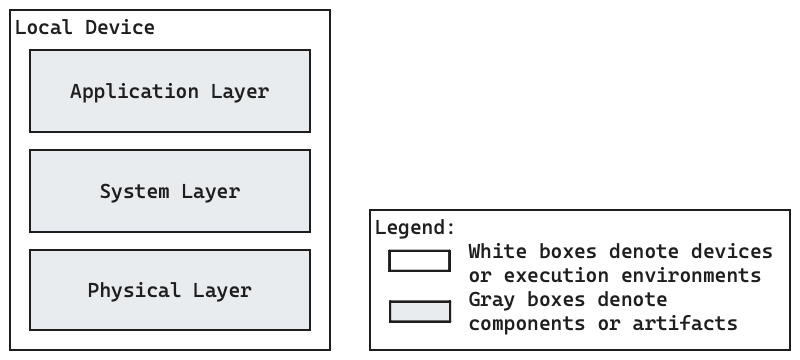
While developing quantum software, it is common try out the software on a local machine. In this most simple scenario, a full instantiation of the quantum software stack is installed on a single non-quantum device such as a developer's laptop or server. As no quantum hardware is available in such a scenario, the physical layer contains a simulator rather than actual quantum device firmware to execute quantum kernels.
Deployment in an HPC Centre
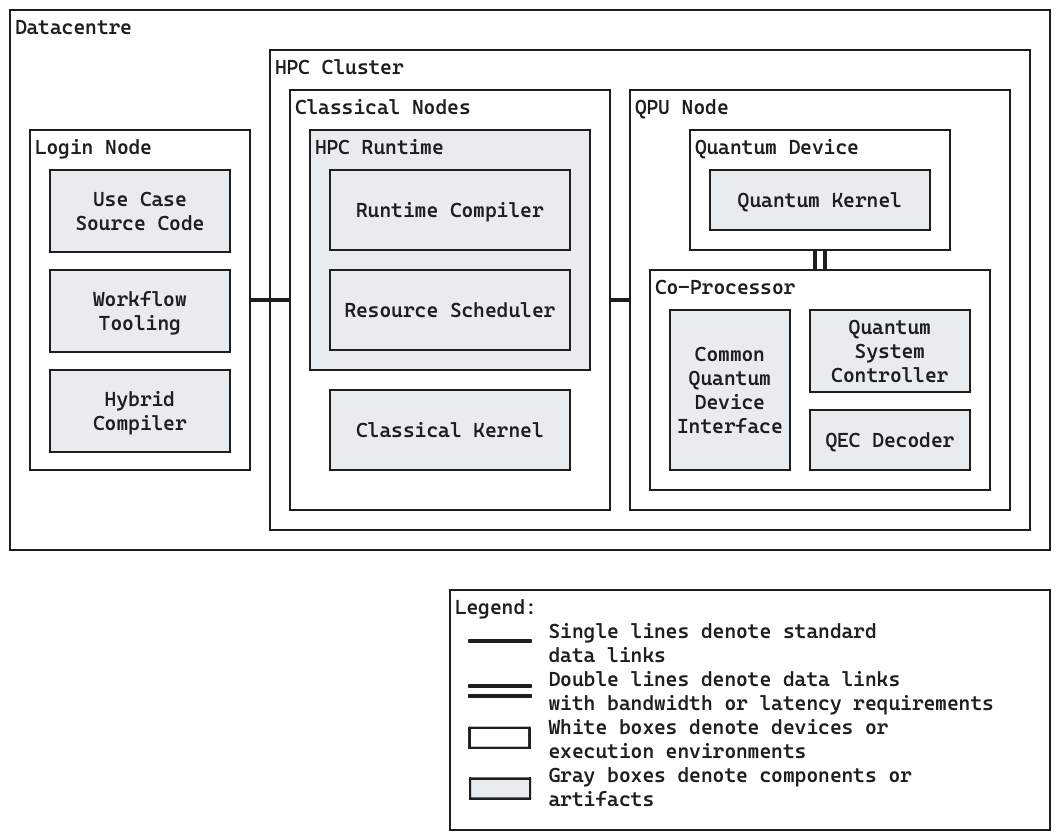
It is a common belief in the quantum software community that quantum computers will be most useful as accelerators in High-Performance Computing (HPC) datacentres. A key feature of HPC clusters is that they integrate enormous amounts of computation resources (such as CPUs, GPUs, and potentially QPUs) to compute solutions to problems that are otherwise impossible to solve.
For the execution of quantum software in an HPC environment, three execution environments are particularly important:
- The Login Node is a machine that acts as an entry point to the datacentre. It allows developers/operators/researchers to bring the Use Case Source Code to the datacentre, and to generate executables for the Quantum and Classical Kernels from it with the Hybrid Compiler.
- The HPC Cluster is at the core of the HPC datacentre. It is made up of CPUs, accelerators (such as GPUs) and storage facilities that allow running large classical workloads such as the Classical Kernel that was compiled on the login node. Beyond the actual workload, the HPC cluster also contains HPC Runtime components such as the Runtime Compiler and the Resource Scheduler which are responsible for distributing the workfload onto the available resources.
- In a quantum software context, a special device within the HPC Cluster is the QPU Node which is made up of a physical Quantum Device (a.k.a. QPU or quantum computer) and a Co-Processor. The Co-Processor is a classical computer that runs the firmware of the Quantum Device so that it can execute the compiled Quantum Kernel. Furthermore, the Co-Processor runs code that requires a low latency or high bandwidth to the Quantum Device such as control flow or QEC Decoder tasks.