Context and Scope
Quantum software systems can be any system that involves tasks solved on quantum computers. The FullStaQD Reference Architecture provides a way to organise the internals of such quantum software systems (see e.g. building block view). In this section, we characterise the boundaries of these quantum software systems as well as typical interactions with external systems and actors. As the FullStaQD Reference Architecture remains highly general, this context specification is highly general too, and we recommend analysing the context and scope again for concrete instantiations of this reference architecture.
Business Context
The business contect describes how the quantum software system interacts with external entities. A brief overview can be seen in the following:
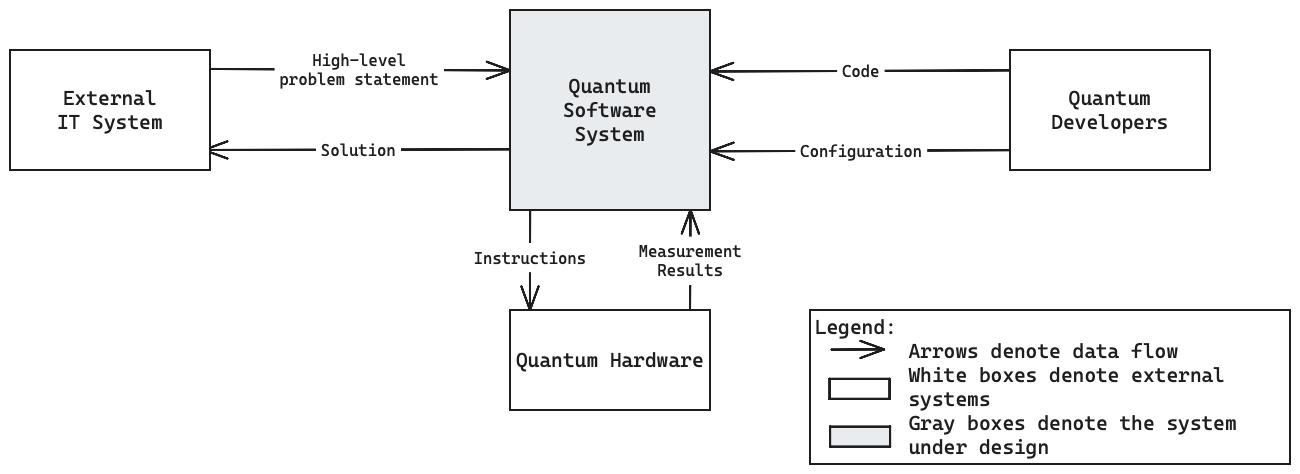
- The Quantum Software System is at the center of the above diagram. Its internal structure, behaviour and deployment are characterised in the respective sections.
-
External IT Systems such as business applications can call quantum software systems with application-specific problem statements. The use of quantum algorithms, problem transformations and circuit formulations is part of application-specific components which are part of the quantum software system (see application layer).
-
Quantum Developers build and compose the internal components of quantum software systems. Quantum developers include quantum and classical software engineers and architects but also quantum theorists like quantum algorithm experts or quantum information theory experts.
- Most quantum software systems control physical Quantum Hardware (although some can use simulators too) by sending low-level hardware instructions (such as pulses) and handling measurement results. Quantum hardware is made available by hardware vendors (either on-premise or through cloud access).
Technical Context
This section adds technical information to the business context presented above.
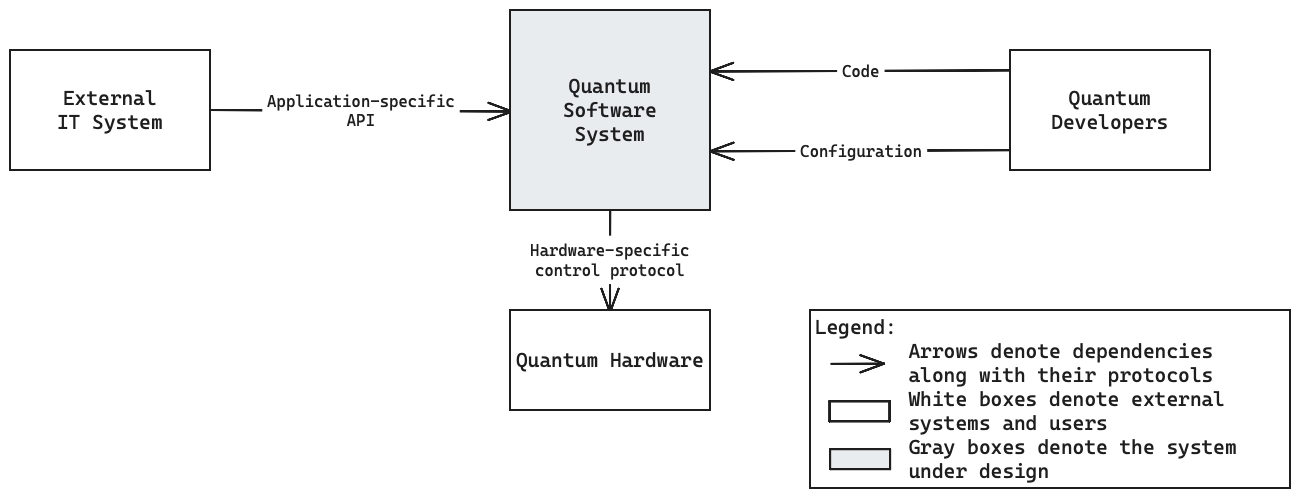
- The interaction between External IT Systems and the Quantum Software System is typically controlled by the external IT system. It calls an application-specific component within the quantum software system (see application layer) with an application-specific protocol.
- Quantum Developers contribute changes to the Quantum Software System in the form of source code. This can be application-specific code written in a quantum programming language but also infrastructure-supporting source code in standard programming languages.
- The protocols that the Quantum Software System uses to control the Quantum Hardware are highly vendor- and hardware-specific. The corresponding compilation passes, drivers and firmware are part of the quantum software system (see physical layer).